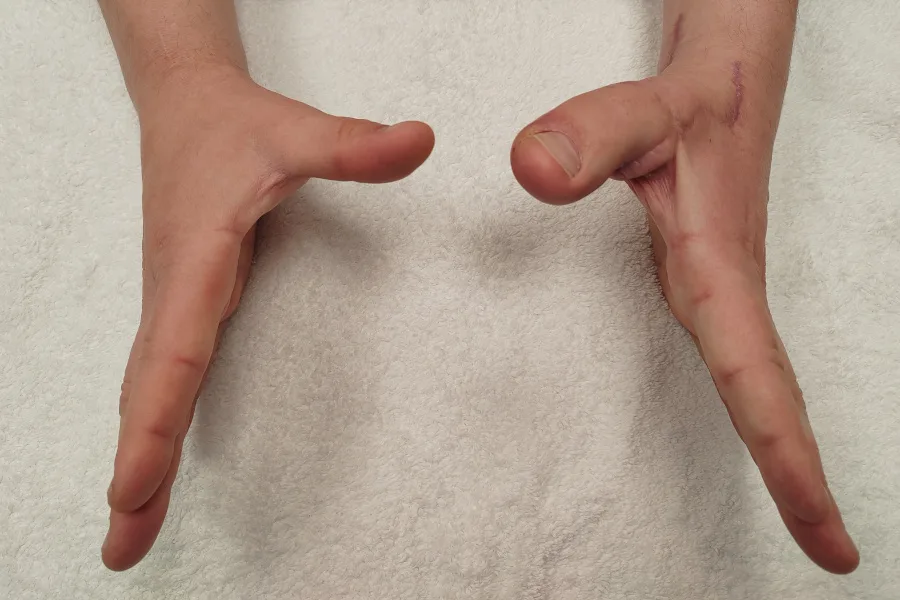
This clinical case study highlights the impact of structured prehabilitation and specialist Hand Therapy in optimising outcomes following a great toe-to-thumb transfer in Northern Ireland. Targeted preparation improved physical readiness, informed patient decision-making and set the stage for exceptional post-operative recovery. Focused rehabilitation enabled rapid gains in strength, dexterity and sensibility, demonstrating the critical role of advanced Hand Therapy in complex reconstructive pathways.
Outcomes of Outpatient Hand Extensor Tendon Injury Repairs in a Regional Plastic Surgery Service
Traumatic thumb loss has profound functional and psychological consequences. The thumb contributes to hand function, playing a critical role in grip strength, pinch, dexterity and activities of daily living. Reconstructive options such as a great toe-to-thumb transfer offer the potential to restore meaningful hand function. However, outcomes are strongly influenced by a patient’s readiness and rehabilitation strategies.
This article highlights the value of prehabilitation in Hand Therapy and targeted post-operative rehabilitation in optimising outcomes following a great toe-to-thumb transplant in Northern Ireland.
Case Overview
A 36 year old, right hand dominant male sustained a severe log splitter injury to his left thumb. The thumb was unsalvageable, necessitating a terminalisation (i.e. surgical amputation) at zone 2. The metacarpophalangeal (MCP) joint and a portion of the proximal phalanx were preserved.
Initially, the patient was reluctant to pursue reconstructive surgery. Concerns regarding surgical burden, recovery time as well as functional expectations contributed to his hesitation. At presentation, he also demonstrated deficits in wrist and finger mobility, limiting his suitability for a complex reconstruction.
The Role of Prehabilitation
Michelle Razo implemented an intensive structured prehabilitation programme to address physical readiness for reconstruction. The goals of prehabilitation included:
- Restoring wrist and digital range of movement
- Improving baseline strength and motor control
- Scar management
- Sensory re-education and desensitisation
- Educating the patient on reconstructive options and realistic outcomes
- Supporting informed decision-making and confidence in the surgical pathway
During this prehabilitation phase, previously deficient wrist and finger mobility improved significantly. As physical capacity increased, so did the patient’s engagement and willingness to consider reconstructive surgery. Ultimately, prehabilitation played a pivotal role in developing an optimal reconstructive surgical candidate and positively influenced the patient’s decision to proceed with a great toe-to-thumb transfer.
Post-Operative Rehabilitation & Outcomes
Following reconstruction, Michelle initiated a structured rehabilitation programme with a focus on:
- Scar management
- Range of movement optimisation
- Manual dexterity retraining
- Progressive strengthening
- Sensory re-education
- Functional task integration
The early rehabilitation period was notable for rapid gains in thumb range of motion and hand strength.
- Grip and two-point pinch strength returned to pre-injury baseline by 11 weeks post-surgery
- Grip strength in the operated, non-dominant hand ultimately exceeded that of the uninjured, dominant hand
- Diminished Protective Sensation and Diminished Light Touch recovered, supporting functional use and safety
One Year Functional Results
At one year post great-to-to thumb transfer, the patient demonstrated:
- Significant improvements in strength and mobility
- Marked gains in manual dexterity
- Meaningful recovery of sensibility
- Visually and objectively impressive functional outcomes
These achievements translated into improved performance in activities of daily living and a substantial enhancement in overall quality of life.
Conclusion
This case demonstrates that prehabilitation is not merely preparatory, but transformative. By improving physical readiness and supporting informed decision-making, prehabilitation positively influenced the patient’s willingness to undergo a great toe-to-thumb transfer and contributed to exceptional post-operative outcomes.
Following reconstruction, early and focused rehabilitation enabled rapid functional recovery, with sustained improvements evident at one year. Strength, mobility, dexterity and sensibility gains were significant, reinforcing the critical role of specialist Hand Therapy across the entire reconstructive journey.
This experience underscores the importance of integrating prehabilitation and rehabilitation into complex reconstructive pathways to maximise functional outcomes and a patient’s holistic wellbeing - particularly in advanced procedures such as great toe-to-thumb transplants.
Support for Patients Following Upper Limb Plastic Surgery
For individuals who have undergone any form of hand, wrist or upper limb plastic reconstructive surgery - recently or in the past - it is not uncommon to experience uncertainty about recovery, ongoing symptoms or functional progress.
Some patients may feel their rehabilitation has plateaued, while others may simply wish to better understand their options moving forward.
Michelle Razo welcomes contact from patients who believe they may benefit from her specialist skills in post-surgery rehabilitation those who are seeking a second opinion regarding their recovery pathway. A fresh clinical perspective can often help clarify goals, optimise rehabilitation strategies and identify opportunities for further improvement in strength, movement, dexterity, sensibility or confidence with hand use.
If you feel you would benefit from expert input following shoulder, upper limb, wrist or hand surgery - or would like to explore whether a tailored rehabilitation approach could enhance your recovery - Michelle encourages you to get in touch to discuss your individual circumstances.